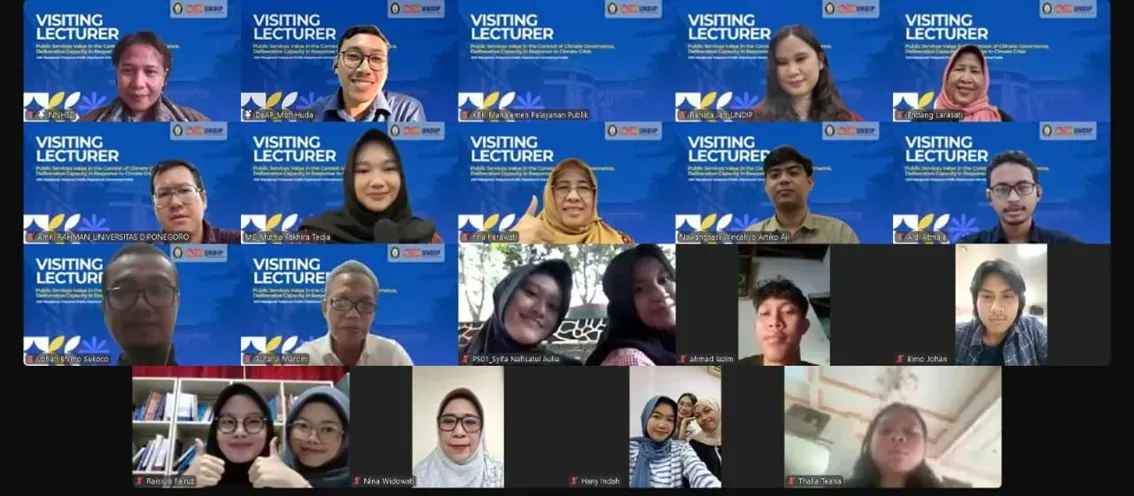
Semarang, 14 May 2025 – The Department of Public Administration, Faculty of Social and Political Sciences, Diponegoro University (FISIP Undip), through the Public Service Management Expertise Group (KBK Manajemen Layanan Publik), once again demonstrated its commitment to addressing global issues through international academic activities. On Wednesday, 14 April 2025, the Expertise Group held an online Visiting Lecturer session featuring climate governance scholar and researcher Dr. Novieta Hardeani Sari, Ph.D., from Newcastle University, United Kingdom.
The event was officially opened by the Dean of FISIP Undip, Dr. Drs. Teguh Yuwono, M.Pol.Admin. In his remarks, he emphasized that universities must serve as strategic spaces for mainstreaming climate change issues within academic discourse in Indonesia. According to him, inviting international experts is a crucial step to ensure that students, lecturers, and researchers gain global perspectives that can inspire local solutions.
In her lecture titled “Public Services Values in the Context of Climate Governance, Deliberative Capacity in Response Crisis”, Dr. Novieta stressed that the climate crisis cannot be addressed solely through technocratic approaches. Climate policy, she argued, must be grounded in public service values such as accountability, transparency, justice, participation, and responsiveness. These values are essential to strengthen policy legitimacy, increase public trust, and ensure social justice, particularly for groups most vulnerable to climate impacts. She also posed several reflective questions, including how public participation can enhance the effectiveness of climate policies, how accountability in climate financing affects long-term support, and how innovative policy communication can sustain citizens’ trust.
Furthermore, Dr. Novieta discussed the role of global deliberation through the Global Assembly (GA), a forum for worldwide citizen participation in discussions on climate change. She presented findings from her research analyzing 56 media articles from 20 countries about the GA, which showed that media coverage remains limited and is still largely concentrated in the United Kingdom and India. British media tend to emphasize the urgency of policy recommendations, while Indian media focus more on increasing public awareness. Although 77 percent of GA participants came from the Global South, only 32 percent of media coverage originated from Global South media outlets, indicating a representation gap. The findings also showed that while the GA successfully encouraged participants to adopt environmentally friendly behaviors, its influence on structural changes in global policy remains limited.
Within the framework of deliberative theory, Dr. Novieta highlighted three dimensions of deliberative capacity as key indicators of climate governance: inclusion, consequences, and authenticity. The GA has been relatively successful in bringing together diverse participants, but the distribution of media coverage remains uneven. The GA’s impact on public awareness appears significant, yet its influence on concrete policy outcomes is still weak. Meanwhile, the authenticity of communication among opinion leaders remains high, as most conveyed direct messages about the urgency of the GA. This underscores that global public deliberation holds great potential but still faces challenges of legitimacy in the policy arena.
She also pointed to ongoing challenges in global climate governance, which remains largely top-down, marked by power imbalances, and constrained by limited infrastructure. Therefore, robust and more inclusive multilateral diplomacy is needed, along with transnational collaboration involving local communities and civil society, and continuous communication capable of building collective awareness across cultures. Such approaches are believed to strengthen the position of the Global Assembly while simultaneously driving social transformation for the sustainability of the planet.
The discussion became even more engaging when Prof. Dr. Dra. Endang Larasati, MS, Head of the Public Service Management Expertise Group, emphasized that public service values must be consistently integrated into every public policy so that they function as instruments of redistribution and social justice. Meanwhile, Dr. Dra. Augustin Rina Herawati, M.Si, added that the climate crisis demands cross-sectoral and cross-country collaboration, as well as the strengthening of the legitimacy of public deliberation in global decision-making. The discussion was dynamically moderated by Mohammad Nurul Huda, S.AP., MPA, who successfully maintained the flow of the forum while opening space for interactive dialogue among speakers, students, academics, and practitioners.
This activity serves as concrete evidence of FISIP Undip’s commitment to expanding international academic networks and bringing global issues into the classroom. Through this forum, students and the academic community gained not only academic insights but also practical understanding of how public service values can become key in governing the climate crisis in an inclusive, democratic, and just manner. The event concluded with optimism that Undip can continue contributing to global discourse while presenting relevant ideas for national development and the sustainability of our planet.