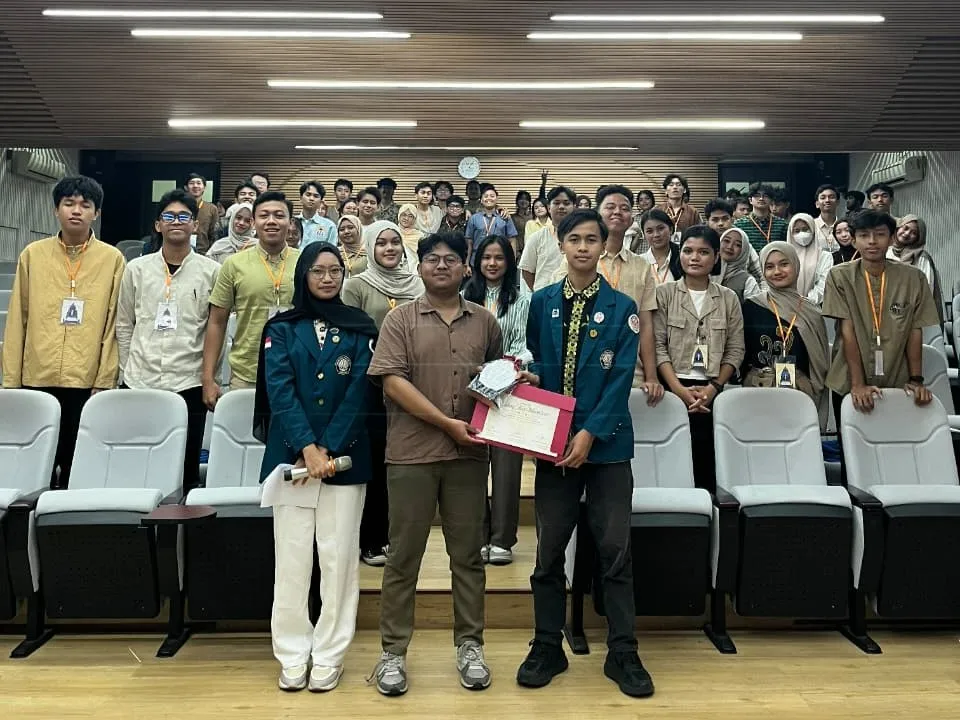
The 2025 FISIP Undip Leadership Training Program has successfully achieved significant milestones in developing participants’ skills and understanding of modern leadership concepts. Through in-depth sessions on the definitions of leadership, position- and influence-based perspectives, and leadership challenges, participants were able to identify and manage personal challenges such as mental fatigue and integrity, as well as team management challenges like motivation and conflict. The leadership pyramid introduced in the program — encompassing managing tasks, managing people, and managing change — provided a practical framework for participants to implement progressive, innovative, and adaptive leadership, equipping them to better navigate the dynamics of a changing world.
In the realm of emotional intelligence, the program effectively dispelled common myths about emotions and emphasized the importance of self-awareness, self-regulation, empathy, and social skills. Participants learned that emotions are not weaknesses but strengths that influence decision-making, team trust, and conflict management. The concept of emotional contagion highlighted how a leader’s emotions can spread within a group. As a result, participants became more capable of managing emotions healthily, enhancing team engagement, and fostering stronger loyalty in leadership contexts. The integration of Smart Goals in strategic planning enabled participants to translate personal visions into concrete actions. Through SWOT analysis and actionable planning, participants—such as FISIP Undip students striving for excellence—were able to set specific, measurable, achievable, relevant, and time-bound goals, including joining organizations or participating in competitions. Inspirational messages shared throughout the program reinforced the idea that “a goal without a plan is merely a wish,” encouraging continuous reflection and practical implementation in both education and leadership.
The session on rhetoric and the art of public speaking further enhanced participants’ persuasive abilities through the pillars of ethos, pathos, and logos, as well as effective delivery techniques. In the context of organizational or student leadership speeches, participants learned to apply Lasswell’s communication model and the visual-vocal-verbal composition to influence audiences—skills applicable in ceremonial, political, and forensic settings. Consequently, participants grew more confident in persuasive communication, an essential competency for leadership in stakeholder management and building positive first impressions.
Stakeholder management using Mendelow’s Matrix provided participants with practical tools to identify, map, and engage relevant parties based on power and interest. Within the context of student projects, participants learned to analyze problems, approach partners, and make effective decisions, contributing to more structured and efficient management of activities such as the ODM. The cultivation of analytical thinking as a core leadership skill was effectively implemented through stages of gathering information, evaluating information, and identifying best practices using the R-E-D model. Participants learned to distinguish analytical thinking from critical and creative thinking and applied it in analyses such as SWOT for the LKMM-PD Communication Science program. This enhanced their ability to think comprehensively and strategically, improving organizational efficiency in achieving collective goals.
Finally, the event planning module—from idea generation to execution—offered comprehensive guidance on organizing events such as the upcoming ODM FISIP Undip 2026. Through stages including needs analysis, project team formation, scheduling, budgeting, communication planning, and risk management, participants learned to avoid common pitfalls and manage planning-related stress. Practical case studies demonstrated quick adaptation in contexts of limited resources and high risks, equipping participants with strategic competencies for success in event management as a form of communicative leadership.
Overall, the program has transformed participants into more competent, innovative, and forward-looking leaders, fully prepared to face future challenges within FISIP Undip and beyond.